


Contrary to the famous belief (that cats are solitary, aloof, or independent by nature), most cats need social interaction and physical stimulation to be healthy. Like humans, if cats don’t have any companion to play with or don’t have anything to do, they get bored soon.
Suppose you leave your cat alone for a long duration (with no other people or animals to interact with). In that case, he is likelier to develop behavioral changes due to boredom. And if not dealt with timely and correctly, it can lead to depression, anxiety, and destructive behavior.
If you are the only person living with your feline friend, your family members are all busy, and your cat is at home alone all day, this article is for you. In this article, you will learn the six common signs cats generally exhibit when they are bored and how you can fix that. Let’s move on.
Table of Contents
Signs of Boredom in Cats
Cats, just like humans, need stimulation and activity to stay happy and healthy. Identifying the signs of boredom in your feline friend is crucial to ensure their well-being.
Below, we will discuss the most common signs that your cat is bored. By being aware of these signs, you can take steps to provide your cat with the right environment, toys, and activities to keep them engaged and entertained.

1. Overeating
We have placed overeating at the top of the list of signs of boredom in cats because cats and humans indulge in eating when they have nothing to do. If you observe that your feline friend has suddenly started eating more than usual, the first thing that should come to your mind must be boredom. If the situation prolongs, it can lead to cat obesity and other related complications like diabetes, hypertension, arthritis, etc.
2. Meowing Or Excessive Vocalization
Generally, cats don’t vocalize too much, not even with other cats. Especially domesticated cats typically meow at their guardians only when they need something or want to divert the owner’s attention toward them.
So if your feline friend is vocalizing more than usual, he might be bored and calling you to play. In addition, excessive vocalization may also mean that he is hungry and needs food or he is in pain and needs medical aid.
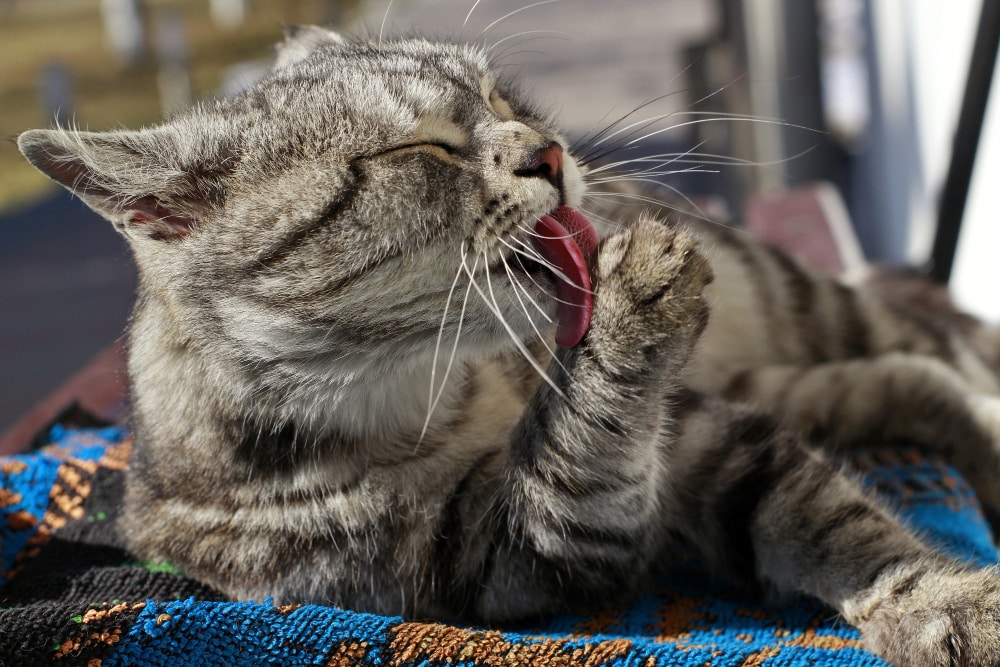
3. Over-Grooming And Repetitive Behaviors
All feline guardians are well aware of the fact that cats spend most of their free time self-grooming. Self-grooming habit helps them keep their body clean, helps maintain body temperature (by evaporating saliva), and ensures skin health (by increasing blood flow to the skin).
Suppose you leave your cat alone for a long and have not made enough arrangements for his physical and mental stimulation. In that case, he will spend more time self-grooming due to boredom. Since cats regularly groom their bodies, it’s difficult for most parents to realize that their fluffy friend is over-grooming now.
A sudden increase in shedding, bald patches, thinning fur, skin rashes, and extra hairballs are common signs of over-grooming. In addition, habits like licking, pulling out fur, and chewing at their skin repeatedly also develop due to boredom.
4. Inactivity
Though cats spend almost 15 hours sleeping naturally, when they are awake, they are active. They spend their time playing, climbing, hunting, and exploring the world. If your cat spends more time napping and is not ready to come out of its sleeping place to perform other activities, your feline friend may feel bored.

5. Aggressiveness / Fighting With Other Pets
Generally, cats go well with other pets (like cats, dogs, guinea pigs, etc.) at home when appropriately introduced. However, a bored cat will become aggressive and try to fight with other pets in the house for no reason.
Suppose you observe your cat misbehaving with guinea pigs, chasing other cats, or attempting to corner the dog. In that case, it’s a sign that your cat is bored and desperately needs mental stimulation.
When no other pets are there to fight, cats may also attack and bite the owner’s ankle or ambush beside a wall and jump on the owner when he passes from there.
6. Destructive Behavior
If you ignore the initial signs of boredom (mentioned above), the boredom can make your cat develop destructive behavior. A bored feline will scratch your bed sheet, carpet, sofa, curtains, or furniture.
Some cats may start knocking down the things placed on shelves, tables, or tops of cupboards. This behavior is so apparent that you can’t ignore it and are forced to pay attention to your cat’s deeds.

How To Fix Boredom Issues In Cat
In short, the fundamental reason for boredom and other related issues is that your cat is not getting enough attention and physical and mental stimulation. And the short answer to the problem is to pay necessary attention to your kitty and provide sufficient physical and mental stimulation. We have given below valuable tips to help your cat fight boredom and enjoy a happy and healthy life.
Spend Time Together
Contrary to the famous notion of being independent, most cats want their owner to spend time with them. Spending at least 20 minutes daily (preferably twice daily) with your cat to make him feel that he is not alone is necessary. Even minor acts like watching TV together, reading a book with the cat in your lap, cuddling, petting him, etc., have a positive influence.
Playing & Grooming
Actively playing with your feline friend at least once daily for 15-20 is an excellent way to provide physical and mental stimulation. In addition, regularly grooming your cat (like brushing, bathing, nail cutting, etc.) gives you an additional opportunity to spend time together. Playing and grooming help your cats avoid boredom and strengthen the mutual bond.

Outdoor Walk
Taking the cat out for a walk is very rewarding. In addition to helping fight boredom, the outdoor walk satisfies a cat’s instinct to explore the world and helps socialize your cat.
Bring a Mate
Bringing another cat or dog is also a good idea to help your cat avoid boredom. If your cat has a companion to play with, he will be less dependent on you for physical and mental stimulation. However, ensure to choose the right breed combination and introduce them appropriately.

How to Catify Your House / Enrich Indoor Environment
Enrich the indoor environment by arranging and decoring the interior of your house so that your cat gets enough physical stimulation and doesn’t feel bored when alone at home.
This is especially crucial for those feline parents who can’t find time to groom, play and go out for an outdoor walk with their cats regularly. Enriching the indoor environment generally includes two things.
Try Arranging a Lot of Toys
The first part of catifying the house is arranging many toys to keep your cat busy. Like a human child, cats also get bored of a toy soon.
So never put all the toys simultaneously in front of your cat; instead, rotate them alternatively to keep your cat interested in the toys. Interactive toys are also available nowadays that are more beneficial to keep your cat physically and mentally stimulated.
Try Arranging Accessories
The second part of catifying the house is to arrange valuable accessories and make necessary installments to fulfill the cat’s instinct. Some commonly used accessories are scratching posts, cat towers, cat trees, cat caves, window perches, vertical perches along the wall at different places, etc. All these accessories are meant to satisfy the cat’s instincts, like scratching, climbing, hiding, sitting in high places, and seeing the world and birds through the window. In addition, such things are helpful to keep the cat busy (both physically and mentally), so he is less likely to feel bored.

Conclusion
In conclusion, cats need stimulation and activity just like humans do. Identifying the signs of boredom in your cat is essential to ensure they are happy and healthy. You can keep them mentally and physically stimulated by providing them with toys, playtime, and interactive activities. Additionally, providing them with a stimulating environment that includes hiding places, scratching posts, and climbing opportunities can also help to prevent boredom.
It’s important to remember that every cat is different and what works for one cat may not work for another. Be observant of your cat’s behavior and try various activities to find out what they enjoy the most. Furthermore, suppose you notice your cat displaying destructive behavior. In that case, it’s always a good idea to consult a veterinarian to rule out any underlying medical issues.
In short, keeping your cat entertained and engaged is crucial to their well-being. By providing them with the right environment, toys, and activities, you can help them lead happy and healthy life.